
What Is a Mangrove Kayak Tour — and Is It Right for You?
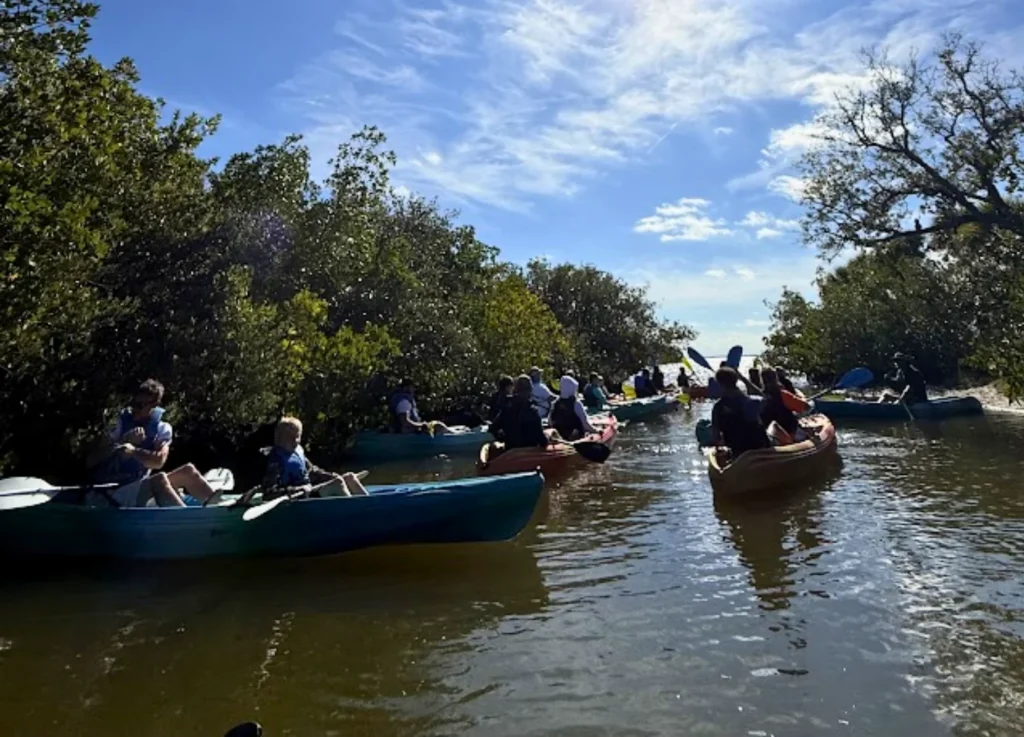
A mangrove kayak tour is a guided paddling experience through coastal mangrove forests, where you navigate narrow waterways, root tunnels, and shallow tidal creeks teeming with wildlife. Here’s the short version of what you need to know:
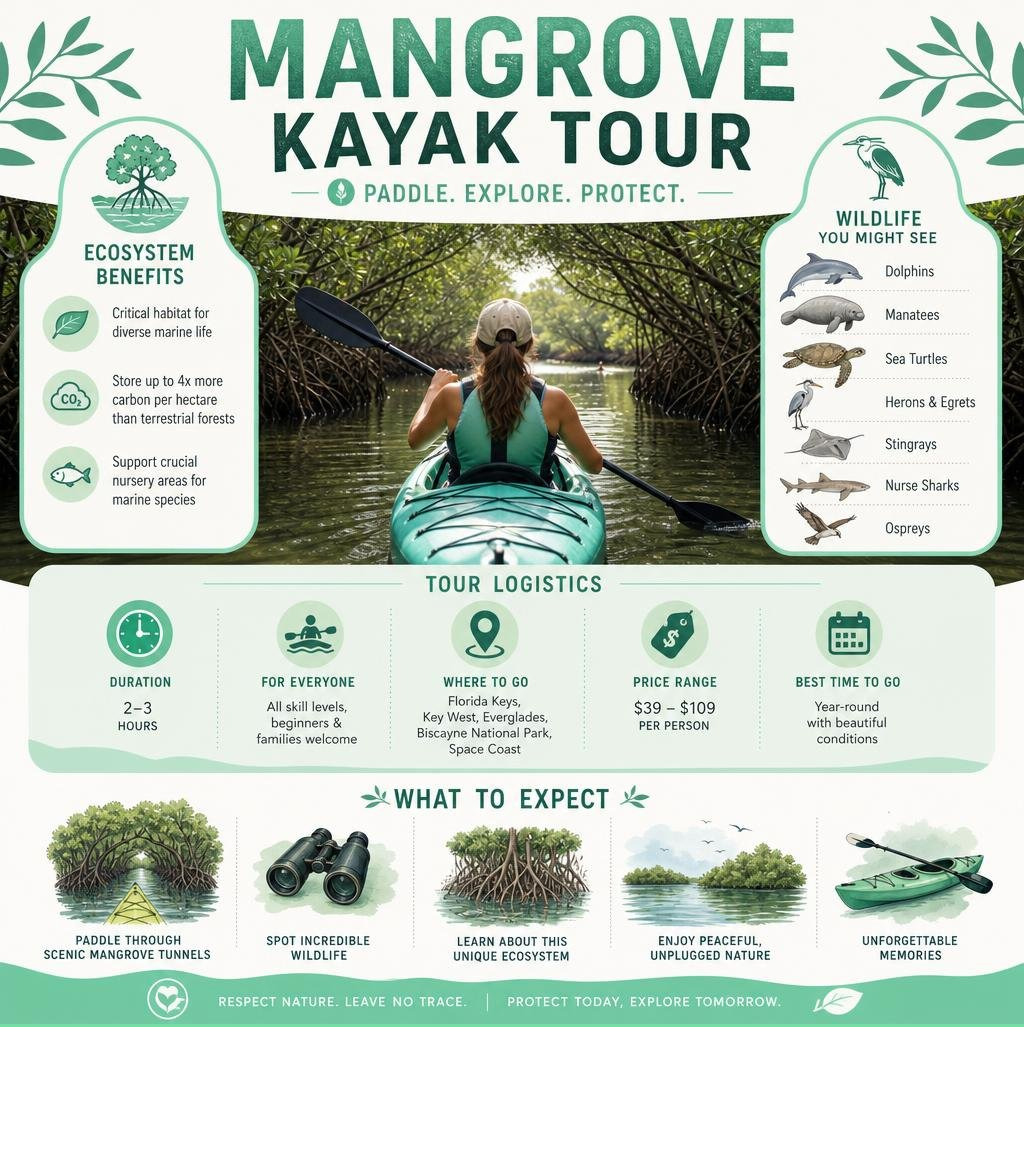
- What it is: A guided kayak trip through mangrove ecosystems, led by a naturalist or eco-tour guide
- Who it’s for: All skill levels, including beginners, families with children, and first-time paddlers
- What you’ll see: Manatees, dolphins, nurse sharks, stingrays, herons, ospreys, sea turtles, and more
- How long: Most tours run 2 to 3 hours
- Where in Florida: Florida Keys, Key West, the Everglades, Biscayne National Park, and Florida’s Space Coast
- Price range: Roughly $39 to $109 per person depending on location, duration, and group type
Mangrove forests support over 1,300 animal species and provide critical nursery habitat for 75% of commercially important fish species. They store up to four times more carbon per hectare than terrestrial forests. Paddling through them isn’t just a fun outing — it’s a front-row seat to one of the most productive ecosystems on the planet.
What makes these tours genuinely special is the access. You can’t experience a mangrove tunnel from a boat. The shallow, root-choked waterways are built for kayaks, not engines. That quiet approach is exactly what lets wildlife behave naturally around you.
I’m Josh Myers, owner of Florida Adventurer and a longtime guide on Florida’s Space Coast, where I’ve led hundreds of mangrove kayak tours through the Indian River Lagoon, Thousand Islands Conservation Area, and Merritt Island National Wildlife Refuge. In this guide, I’ll walk you through everything you need to plan your trip — from choosing the right location to knowing what to pack.
Is a Mangrove Kayak Tour Worth It?
For many Florida visitors, yes — a mangrove kayak tour is worth it if you want a calm, scenic, nature-focused experience that feels very different from a beach day, boat ride, or theme park itinerary. It is especially good for travelers who want to slow down, get close to wildlife, and explore places larger boats cannot reach.
You can’t experience a mangrove tunnel from a boat. That is the biggest reason guided paddling tours feel so memorable. A kayak lets you slip into narrow shaded channels, float beside red mangrove roots, pause quietly for wildlife, and move through shallow backwaters without the engine noise of a larger vessel.
A mangrove tour is usually a great fit if you want:
- A relaxed outdoor activity that does not require previous kayaking experience
- Wildlife viewing in a quiet, natural setting
- A break from crowded beaches, theme parks, or high-speed boat tours
- A guided experience where someone else handles route planning, tides, and safety
- A trip that works well for couples, families, photographers, and first-time paddlers
A mangrove kayak tour isn’t the right fit for every traveler. If your main goal is crystal-clear swimming water, fast-paced adventure, or a guaranteed single-species wildlife encounter, another experience may be a better match. If you want cool freshwater and swimming, a spring paddle may be better. If you want the most unusual nighttime experience on the Space Coast, bioluminescence may be the stronger choice. If dolphins are your only priority, choose a route and season known for dolphin activity rather than booking any generic mangrove trip.
As a guide, the biggest thing I tell guests is this: mangrove kayaking is not about covering the most miles. It is about moving slowly enough to notice what is happening around you — the bird tucked into the branches, the mullet jumping across the flat, the manatee nose breaking the surface, or the sudden quiet when your group enters a shaded tunnel. That slower pace is also what makes kayaking in the mangroves feel so different from a standard open-water paddle.
Top Locations for Mangrove Paddling in Florida
Florida has several excellent mangrove paddling regions, but they do not all deliver the same experience. Some are better for clear water, some for wilderness, some for beginners, and some for reliable wildlife viewing. If you are choosing a vacation activity, it helps to compare locations by what you actually want from the tour.
| Best For | Location | Why It Stands Out |
|---|---|---|
| Wildlife viewing | Space Coast / Indian River Lagoon | Strong opportunities for manatees, dolphins, birds, and calm lagoon paddling. |
| Beginners | Thousand Islands, Cocoa Beach | Protected channels, accessible launch areas, and varied routes for different conditions. |
| Clear water scenery | Florida Keys / Key West backcountry | Shallow, clearer flats with sponges, rays, nurse sharks, and tropical marine life. |
| Wilderness feel | Everglades / Turner River | Longer, more remote routes with dense canopy, birds, alligators, and backcountry conditions. |
The Florida Keys and Key West Backcountry
The Florida Keys are a great choice if you want clear, shallow water and a more tropical feel. In the Key West backcountry, paddlers often glide through winding creeks, sandy shallows, grass flats, and mangrove edges where the water can be clear enough to spot sponges, sea cucumbers, upside-down jellyfish, rays, and juvenile nurse sharks.
Choose the Keys if your ideal tour is visual, warm, and marine-life focused. The tradeoff is that popular areas can be busy, and conditions may feel more exposed when wind picks up across open flats.
The Everglades National Park and Turner River
The Everglades are best for visitors who want a wilder, more remote paddling experience. Routes like Turner River can move from freshwater habitat into brackish mangrove tunnels and eventually toward the Ten Thousand Islands, creating a stronger expedition feel than a short vacation paddle.
Choose the Everglades if you are comfortable with a more rugged outing, longer logistics, and less predictable conditions. It can be incredible, but it is not always the simplest choice for families, nervous beginners, or travelers who want an easy half-day activity.
Florida’s Space Coast and the Indian River Lagoon
For many visitors staying near Cocoa Beach, Orlando, Merritt Island, Titusville, or Kennedy Space Center, the Space Coast is one of the most practical and rewarding places to book a mangrove kayak tour. The Indian River Lagoon, Banana River, Thousand Islands Conservation Area, and nearby protected backwaters combine accessible launch points with strong wildlife potential.
This is where local guide experience matters. On the Space Coast, conditions can change quickly with wind, tide, boat traffic, and wildlife movement. A good guide can choose protected channels, adjust the pace for first-time paddlers, and help guests notice animals they would likely miss on their own.
If you are searching for mangrove kayaking near me while staying near Orlando, Cocoa Beach, or Kennedy Space Center, the Space Coast is often the easiest place to pair a half-day paddle with the rest of your trip.
If you are traveling from the theme park area, read our guide to the Best Place to Go Kayaking in Orlando, Florida to plan an easy coastal escape.
What to Expect on the Water
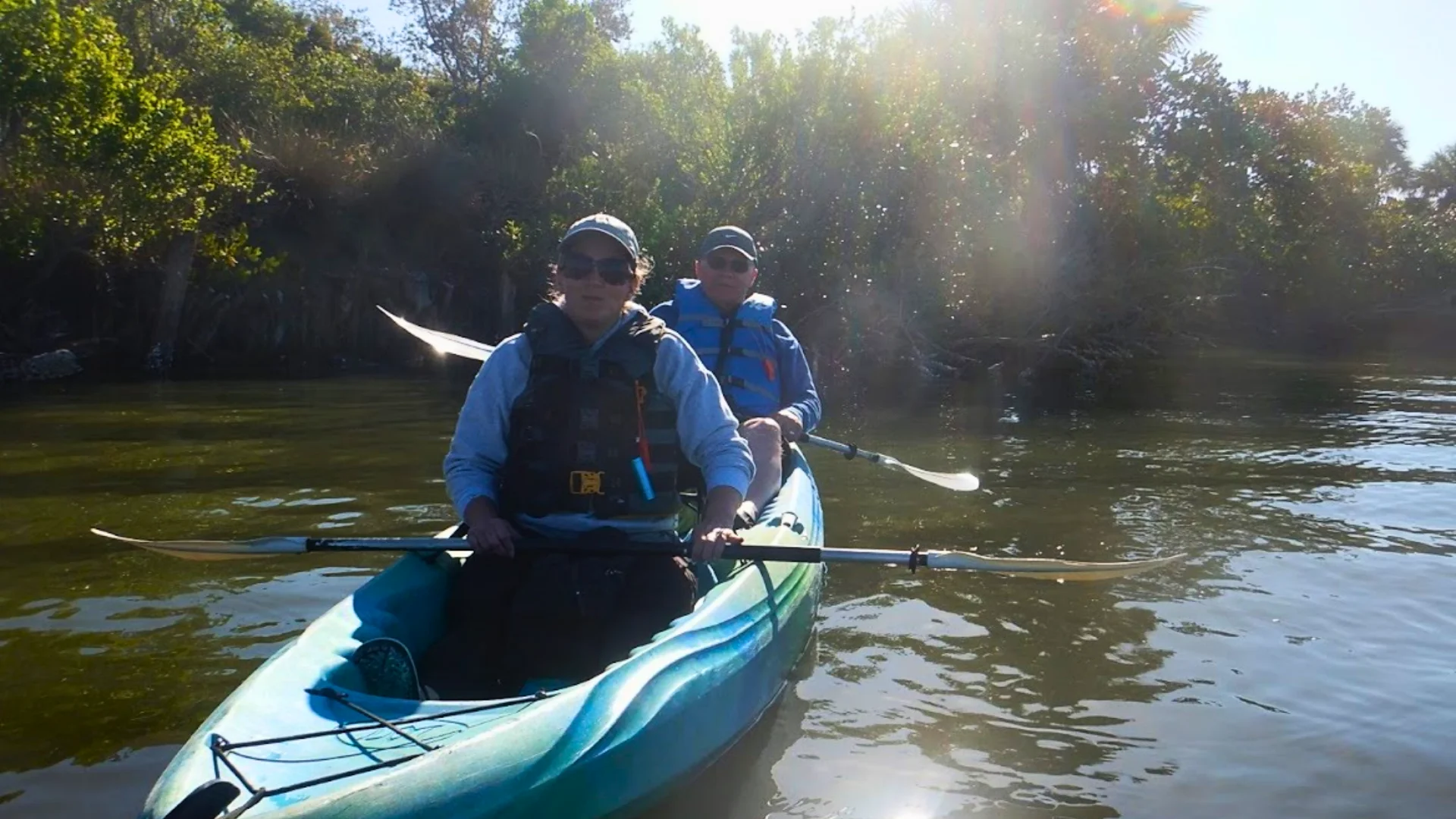
A mangrove kayak tour usually feels calmer, quieter, and more varied than first-time guests expect. Most trips are not one continuous tunnel from start to finish. Instead, they often alternate between narrow mangrove corridors, open lagoon sections, shallow flats, protected side channels, and quiet wildlife-viewing areas.
That variety is part of the appeal. One minute you may be ducking beneath low branches in a shaded tunnel, and a few minutes later you may be drifting across an open flat while your guide points out birds, fish, manatee signs, or dolphin activity in the distance.
What Surprises First-Time Guests
Guests often expect mangrove kayaking to feel like paddling through dense jungle the entire time. In reality, most mangrove kayaking tours alternate between narrow mangrove tunnels, open lagoons, shallow flats, and quiet wildlife viewing areas.
The other surprise is how much the pace changes. In the open water, you paddle steadily enough to stay together as a group. Inside the tunnels, everything slows down. You use shorter strokes, steer around roots, pause to let the kayak glide, and sometimes gently push off a branch or root system without damaging it.
First-time paddlers are also often surprised by how stable sit-on-top kayaks feel. Most guests relax after the first few minutes once they realize the goal is not speed or perfect technique. The best tours give you time to get comfortable before entering tighter areas.
Wildlife You May See
Wildlife is one of the main reasons people choose a mangrove kayak tour, but it is important to approach it with realistic expectations. These are wild animals, not scheduled attractions. Your guide can improve your chances by choosing smart routes, reading the water, and spotting subtle signs, but no ethical operator can guarantee a specific animal every time.
Depending on location and season, guests may see manatees, dolphins, herons, egrets, ospreys, pelicans, stingrays, mullet, crabs, sea turtles, nurse sharks, and many smaller fish using the mangrove roots as shelter. On the Space Coast, manatees and dolphins are two of the most exciting possibilities, especially in the Indian River Lagoon and Banana River areas.
The best wildlife moments are usually quiet ones. A small group that paddles slowly, listens to the guide, and gives animals space will almost always have a better experience than a noisy group racing from one spot to the next.
Choosing the Right Mangrove Kayak Tour for Beginners
If you have never paddled before, a mangrove tour can be one of the best ways to start. Protected mangrove channels often have calmer water than exposed open-water routes, and a guided trip begins with basic instruction before you launch.
A professional guide will show you how to paddle forward, turn, stop, reverse, and maneuver through tighter spaces. They will also explain where to keep distance from roots, how to avoid blocking other kayaks, and what to do if wind or current affects the group.
For beginners comparing mangrove kayaking tours, look for small guided groups, stable sit-on-top kayaks, clear safety instruction, and an operator that adjusts routes based on the day’s conditions. Smaller groups also make it easier to hear your guide, stay together, and adjust the pace for families or nervous paddlers. For more confidence before your trip, review our Kayaking Safety Tips.
How to Prepare and What to Bring
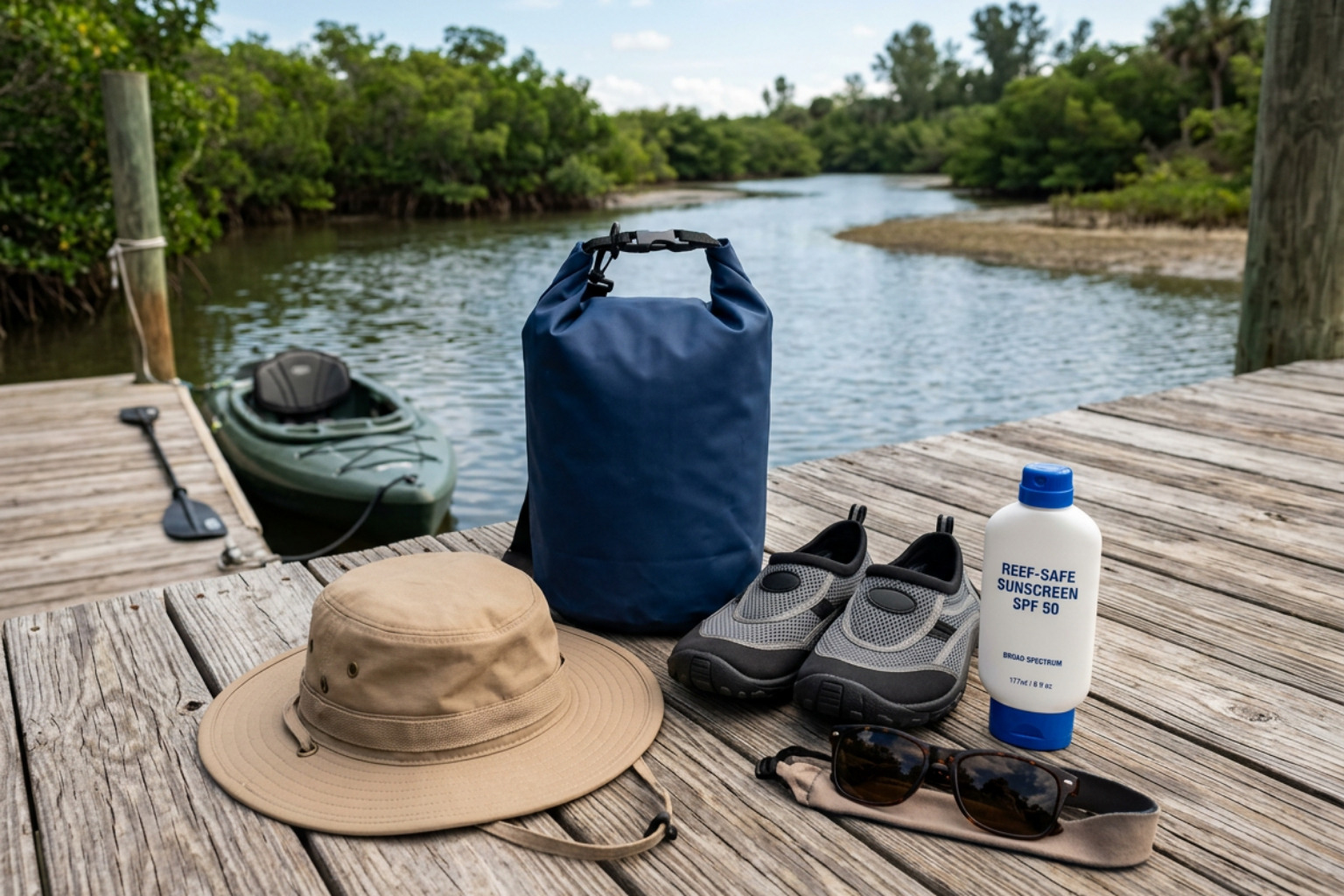
Since you will be paddling in shallow coastal water, expect to get at least a little damp. Wear lightweight, quick-drying clothing, secure water shoes or sandals, a hat, and polarized sunglasses if you have them.
Bring reef-safe sunscreen, drinking water, insect repellent, and a small dry bag for your phone, keys, or camera. Avoid flip-flops, bulky bags, and anything you would hate to lose in the water.
For a comprehensive guide on packing and setting realistic expectations, check out our detailed article on How to Prepare for Your Kayak Tour.
Who Should Choose a Mangrove Kayak Tour?
A mangrove kayak tour is not just one type of experience. Different guests enjoy it for different reasons, which is why it works well for a wide range of vacation styles.
Families
Families often like mangrove tours because the pace is slower than many adventure activities, the scenery changes throughout the route, and kids have plenty to look for along the way. A good guide keeps the group moving, points out wildlife, and helps younger paddlers understand what they are seeing without turning the trip into a lecture.
Photographers
Photographers tend to enjoy the contrast between shaded tunnels, open water, birds, reflections, and close-up root textures. Morning light can be especially good, and a guide who understands the route can help position the group without disturbing wildlife.
Birders
Mangrove shorelines are excellent places to watch herons, egrets, ospreys, pelicans, ibis, and other coastal birds. Birders should choose slower tours with smaller groups, because quiet paddling gives guides more chances to stop, listen, and point out movement along the branches and flats.
First-Time Paddlers
First-time paddlers benefit from guided instruction, stable kayaks, and routes selected for current conditions. Mangrove tours usually reward patience more than athletic ability, which makes them a comfortable introduction to kayaking for many guests.
Wildlife Lovers
If you love seeing animals in their natural habitat, mangrove kayaking is a strong choice. The best tours combine realistic expectations with expert spotting. Your guide may notice a manatee swirl, a dolphin feeding pattern, a ray moving across the flat, or a bird tucked deep into the branches before anyone else sees it.
Couples
Couples often enjoy mangrove tours because they feel peaceful and immersive without requiring a full-day commitment. Tandem kayaks can be a fun option if both people are comfortable working together, while singles are better if each person wants more control.
Why Guides Matter More in Mangrove Tunnels
A guide matters on almost any kayak tour, but mangrove tunnels make local experience especially valuable. These routes can look simple on a map and confusing on the water. Narrow channels split, dead-end, shift with tide levels, and change dramatically depending on wind direction and water depth.
An experienced guide helps with:
- Navigation: Knowing which channels connect, which ones dead-end, and which routes are realistic for the group’s ability level.
- Tides: Understanding when shallow areas are passable, when tunnels are too tight, and when open-water sections may be more difficult.
- Wildlife spotting: Noticing subtle signs such as bird behavior, surface movement, feeding activity, or manatee breath patterns.
- Guest comfort: Adjusting the route, pace, and instruction for beginners, families, larger groups, or nervous paddlers.
- Low-impact paddling: Helping guests avoid damaging roots, crowding wildlife, or disturbing sensitive habitat.
This is where firsthand guiding experience changes the quality of the trip. A good guide is not just reciting facts about mangroves. They are reading the water, watching the group, choosing the best route in real time, and helping guests understand what they are experiencing as it happens. For guests comparing mangrove kayak options, that local judgment can be the difference between a generic paddle and a tour that fits the day’s conditions.
Why We Love Guiding Mangrove Tours
One of our favorite moments is watching first-time paddlers realize how quiet the mangrove tunnels become once the group stops paddling. You can hear the water drip from the paddle blades, birds moving in the branches, fish breaking the surface, and the small sounds of the lagoon that are easy to miss from shore or from a motorboat.
That is what makes these tours rewarding to guide. Guests often start the trip focused on whether they will see a manatee, dolphin, or tunnel. By the end, they usually remember the feeling of slowing down, drifting through the shade, and noticing details they would have passed by on their own.
For us, a great mangrove kayak tour is not about rushing through as many channels as possible. It is about helping guests feel comfortable enough to look around, ask questions, and experience the Space Coast from water level.
The Mangrove Ecology You Actually Need to Know
You do not need a botany lesson to enjoy a mangrove kayak tour, but a little context makes the experience more meaningful. Florida has three main mangrove species, and each one helps shape what you see from the kayak.
Red mangroves usually grow closest to the water and are the ones most guests picture first. Their arching prop roots create the tunnel-like edges and underwater shelter where small fish, crabs, and other animals hide.
Black mangroves often grow slightly farther inland and send small root projections up from the mud. Guides may point them out at lower tide, especially in areas where the shoreline looks spiky or textured.
White mangroves tend to grow at slightly higher elevations and help complete the coastal buffer. You may not notice them as quickly from the water, but together with red and black mangroves, they help stabilize shorelines and protect nursery habitat.
The practical takeaway for paddlers is simple: mangroves create calm, protected, wildlife-rich spaces that kayaks can explore gently. Their roots reduce wave energy, shelter young marine life, and create the shaded tunnels that make these tours so different from ordinary open-water paddling. According to NOAA, mangroves also protect shorelines from storm surge, erosion, and waves, which is part of why conservation matters in the same places visitors love to explore.
Frequently Asked Questions About Mangrove Kayaking
Are mangrove kayak tours safe for non-swimmers?
Yes, mangrove tours are generally safe for non-swimmers when booked with a reputable operator. Guests wear Coast Guard-approved life jackets, use stable kayaks, and stay with a trained guide. Many mangrove routes are also shallow, though depth varies by location and tide.
Are mangrove kayak tours good for kids?
Yes, mangrove kayak tours can be a great fit for kids because the pace is usually calm, the scenery changes often, and there is plenty of wildlife and natural detail to look for along the way. The best choice is a guided tour with stable kayaks, clear safety instruction, and a route that can be adjusted for wind, tide, and the group’s comfort level.
Age policies vary by operator, so check Florida Adventurer’s current booking details before reserving. If you are bringing younger children, ask whether tandem kayaks are available, what the minimum age is, and whether the day’s route is appropriate for first-time paddlers.
Will I paddle through mangrove tunnels the entire time?
Usually, no. Most mangrove kayak tours include a mix of shaded mangrove tunnels, open lagoon water, shallow flats, and protected side channels. That variety is part of what makes the experience interesting, and it also gives guides flexibility to choose the best route for the day’s conditions.
If paddling through tunnels is your main priority, ask the operator how much tunnel time is typical for that route and season. Tide, wind, water depth, and group ability can all affect how much time you spend inside tighter mangrove areas.
What is the best time of day to see wildlife in the mangroves?
Morning tours are often best for wildlife because temperatures are cooler, winds are usually lighter, and birds tend to be active. Tide also matters. Higher water may allow access to tighter mangrove areas, while lower water can expose mudflats where birds and crabs feed.
Do mangrove tunnels have spiders or snakes?
Mangrove forests are natural habitats, so insects, crabs, and occasional snakes can live there. In practice, most guests mainly notice birds, fish, crabs, roots, and scenery. Wildlife generally avoids people, and guides help guests move through tunnels calmly and safely.
Conclusion
Whether you are looking for wildlife, peaceful paddling, or a chance to experience one of Florida’s most remarkable coastal ecosystems, a guided mangrove kayak tour offers an experience that is difficult to replicate anywhere else. You get close to the water, move quietly through protected habitat, and explore places that larger boats simply cannot reach.
With the right guide and the right conditions, a mangrove kayak tour often becomes one of the most memorable parts of a Florida vacation. It is a chance to slow down, notice more, and see the Space Coast from a perspective most visitors miss.
About Josh Myers
Josh Myers is the owner of Florida Adventurer and a longtime Space Coast kayak guide with extensive experience leading guests through the Indian River Lagoon, Thousand Islands Conservation Area, Merritt Island National Wildlife Refuge, and nearby Cocoa Beach waterways. His guiding approach focuses on safety, small group experiences, responsible wildlife viewing, and helping visitors understand the conditions, routes, and ecosystems that make each paddle different.
About Florida Adventurer
Florida Adventurer specializes in guided kayak experiences across Florida’s Space Coast. We offer bioluminescence tours, clear kayak adventures, manatee encounters, and dolphin sightings in the Indian River Lagoon and Cocoa Beach areas. Focused on safety, small group sizes, and environmental stewardship, our local guides provide educational and responsible wildlife viewing experiences for adventurers of all skill levels.
Ready to Experience It Yourself?
If you are ready to trade the hum of the city for the peaceful rustle of the coastal wetlands, we are here to help you get on the water. While daytime paddling through the mangroves is spectacular, the adventure does not have to end when the sun goes down.
On the Space Coast, our night paddling trips offer a completely different kind of magic. As darkness falls over the lagoon, the water can come alive with a cold, electric-blue glow. If you want a memorable Florida paddling experience guided by local experts, book one of our guided bioluminescence kayak tours and see the water glow with every stroke of your paddle.